
Epictia venegasi
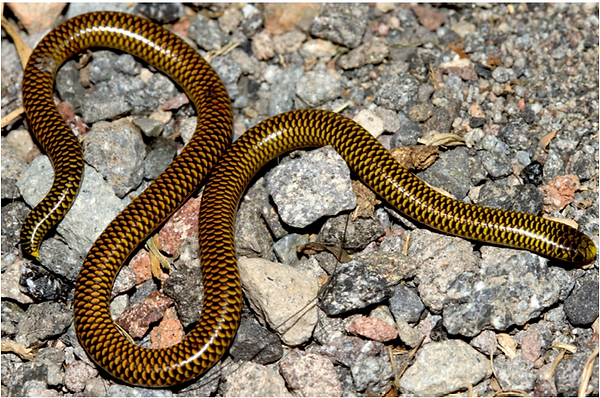
Image source: Koch et al. (2016).
Author: Roy Santa Cruz Farfan
Range: Northern Peruvian Andes, near Cajamarca
This striking blindsnake species is a unique high elevation endemic described in 2016. It grows to at least 20 cm in length, with a cylindric but fairly thick body for the genus .The head is slightly flattened and rounded, only barely wider than the neck, with a slightly pointed rostral region, and the tail is short and blunt, slightly tapered just before a prominent terminal spine. Dorsal scale count is 211-221, scale row count 14 reduced to 10 caudally. Coloration is unique, often dark brown, gray, or black on the head and tail but all other scales typically bicolor, either ringed or flanked in the front or back with brown to gray-black on a gold to tan-yellow background, both dorsally and ventrally though the latter is often darker. The rostral and tail-spine scales are usually adorned with cream to yellow blotches as well, if all scales aren’t bicolor. This species is easily recognizable by this coloration and its range as well as a large anterior supralabial (above upper lip) scale.
Habitat: recorded from the type location only, between 2500-2750 meters in elevation in rocky montane scrubland, under rocks and other cover.
Prey: likely small soft-bodied invertebrates such as ant and termite larvae.
Lifespan and reproduction: lifespan unknown, likely under 10 years. Oviparous.
Sources: Koch et al. (2016). Two new endemic species of Epictia Gray, 1845 (Serpentes: Leptotyphlopidae) from Northern Peru. Zootaxa 4150(2): 101-122.